"Planets for Kids: Fun Facts About the 8 Planets"
The eight planets in order from the Sun, three simple facts about each one that a 4- to 6-year-old can remember, an easy way to learn the order, and free printable planet pages with real NASA photos.
By Cozy Learners · · 3 min read
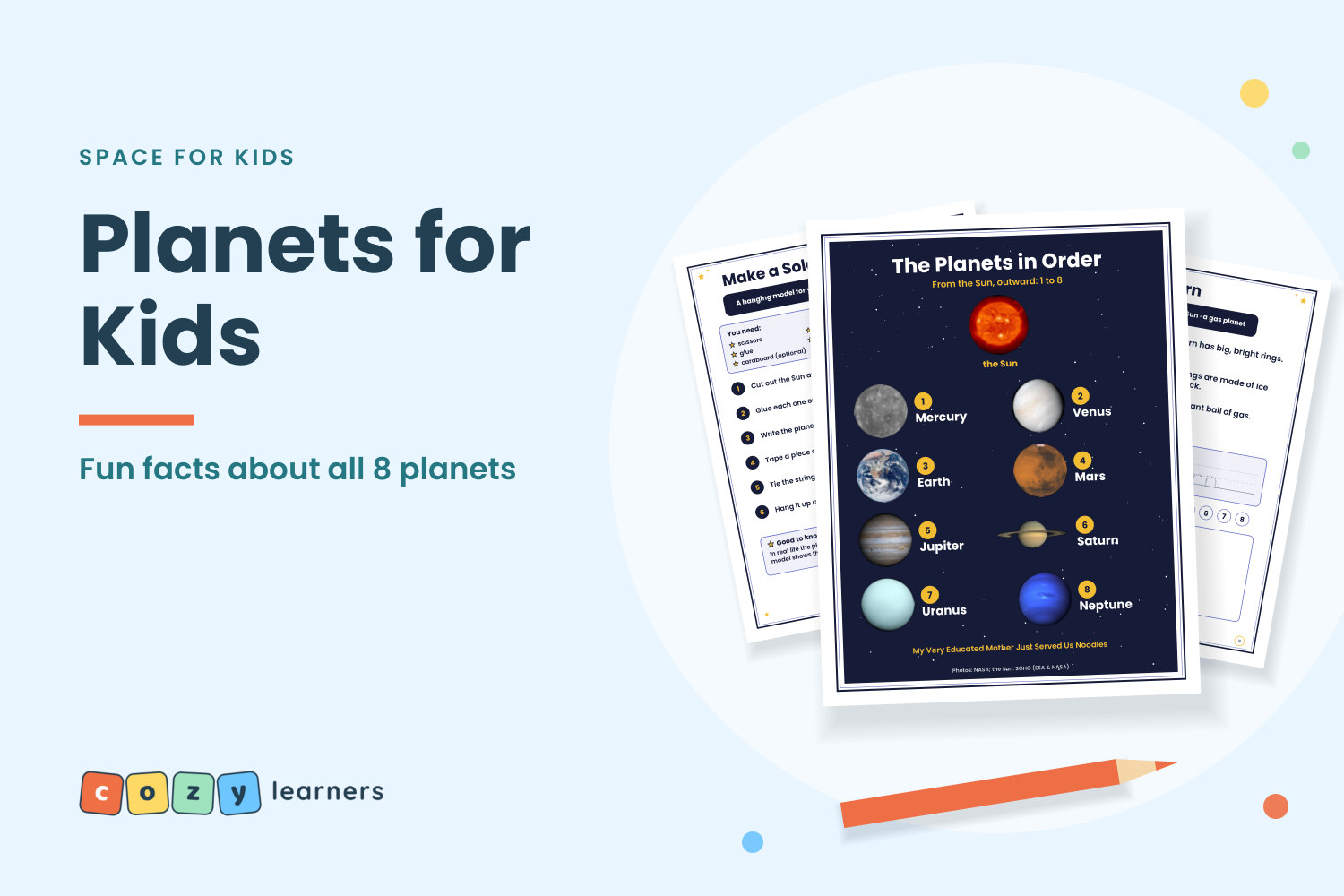
Our solar system has the Sun in the middle and eight planets going around it. Four are small and rocky, four are giant. Here they are in order, starting from the Sun, with three facts about each — just enough for a young child to remember.
The Sun
The Sun is a star, the closest star to us. It is a giant ball of very hot gas, and every planet goes around it. One rule to teach first: never look straight at the Sun.
1. Mercury
- Mercury is the closest planet to the Sun.
- It is the smallest planet.
- It is covered in holes called craters.
2. Venus
- Venus is the hottest planet — even hotter than Mercury.
- Thick clouds cover it all the time.
- It shines bright in the night sky.
3. Earth
- Earth is our home.
- It has water, air and living things.
- It has one moon: the Moon.
4. Mars
- Mars is the Red Planet.
- Its red dust is like rust.
- Robot cars called rovers drive on Mars.
5. Jupiter
- Jupiter is the biggest planet.
- It is a giant ball of gas.
- Its big red spot is a storm.
6. Saturn
- Saturn has big, bright rings.
- The rings are made of ice and rock.
- It is a giant ball of gas.
7. Uranus
- Uranus is blue-green.
- It spins on its side, like a rolling ball.
- It is very, very cold.
8. Neptune
- Neptune is the farthest planet from the Sun.
- It is deep blue.
- It has the strongest winds of all.
How to remember the order
A silly sentence helps: My Very Educated Mother Just Served Us Noodles. Each word starts like a planet — Mercury, Venus, Earth, Mars, Jupiter, Saturn, Uranus, Neptune. Say it together, then let your child make up their own.
And Pluto? Pluto used to be called the ninth planet. In 2006, scientists decided to call it a dwarf planet, because it is much smaller than the other eight.
Easy planet activities
- Line up the planets. Draw eight circles on paper, cut them out and put them in order on the floor, from the Sun outward.
- Big and small. Find eight round things at home — a pea, a grape, a ball — and decide which planet each one could be.
- Day and night. In a dark room, shine a flashlight on a ball and turn it slowly: one side has day, the other has night.
- Look up. On a clear evening, look for the Moon, and ask your child what shape it is tonight.
Free planet printables
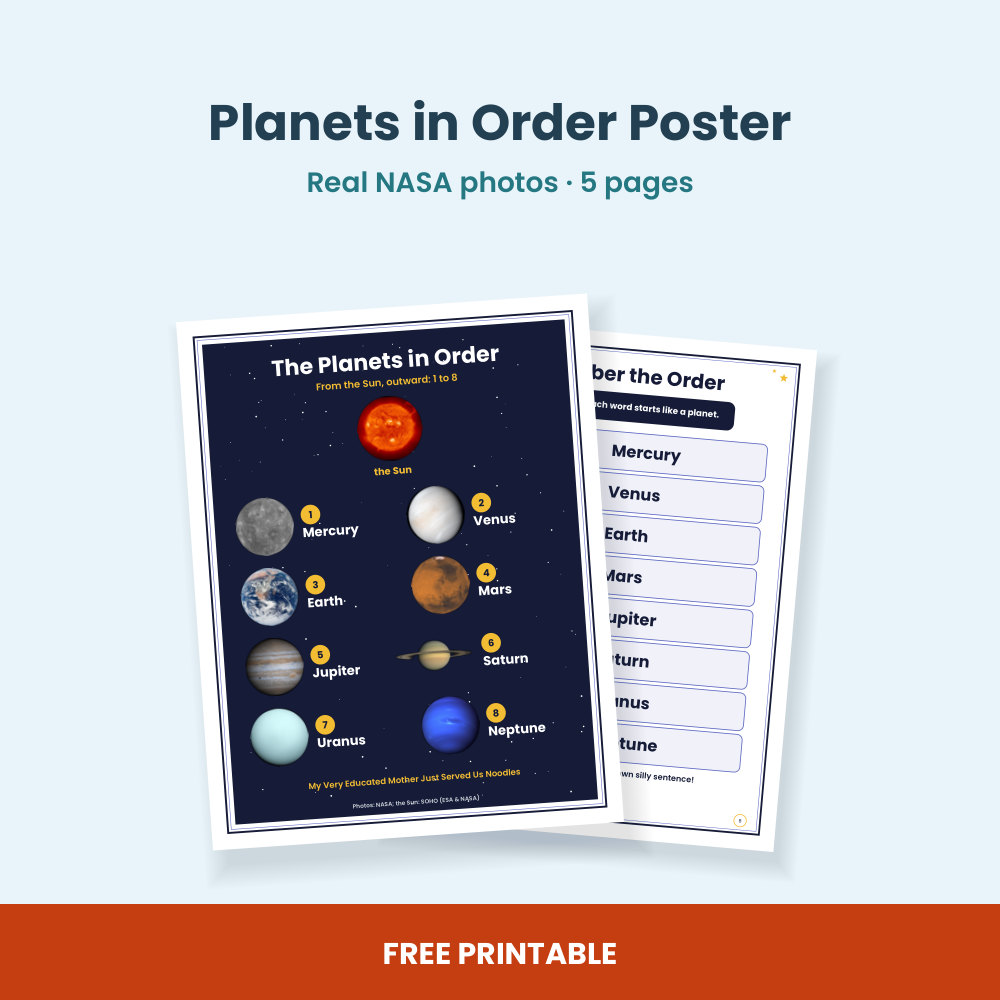
- Our free planets in order poster has real NASA photos, the silly sentence and a cut-and-glue page.
- Our free space coloring pages: a rocket, an astronaut, Saturn and a sleepy moon.
A whole space unit
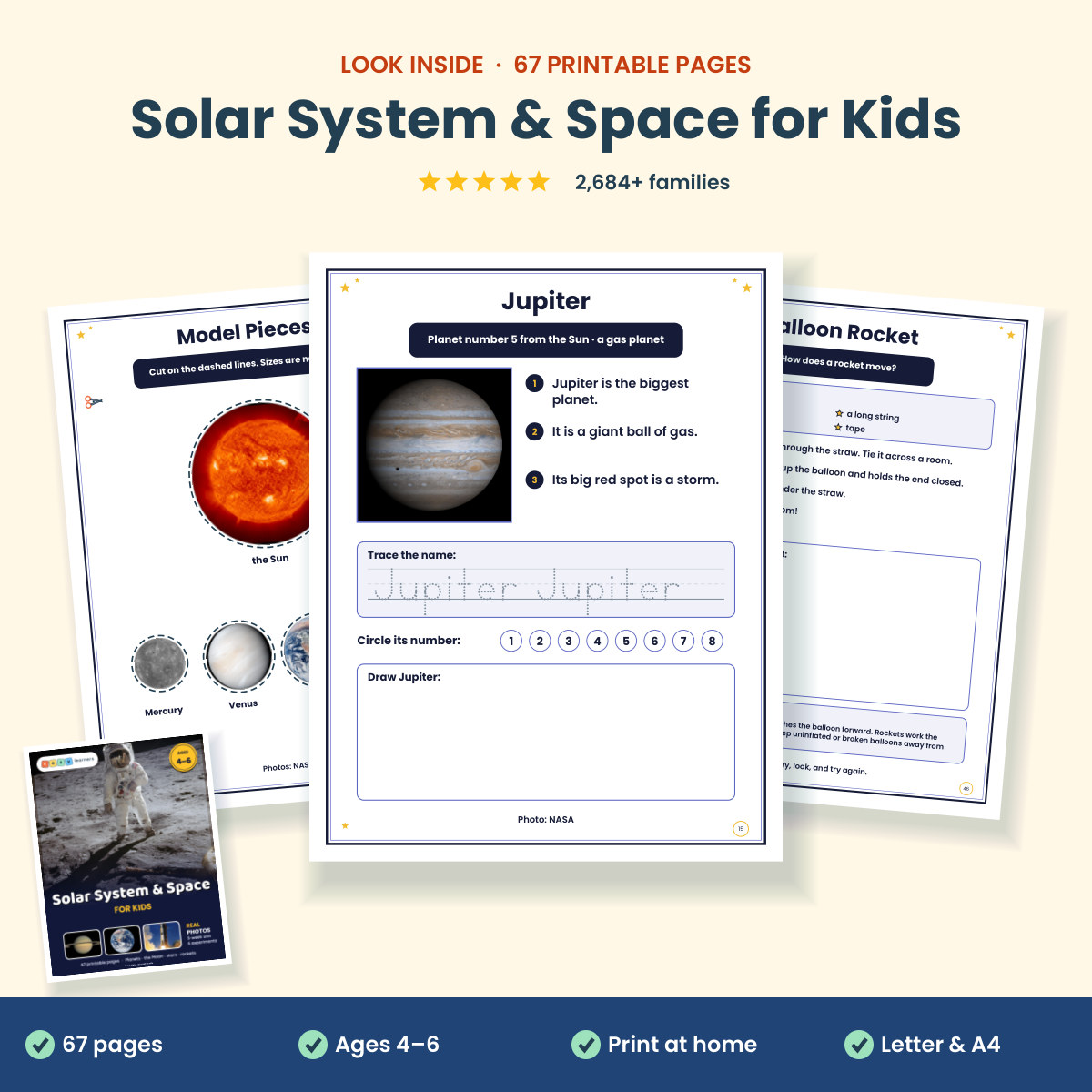
Solar System & Space for Kids is a 3-week unit for ages 4 to 6: a page for each planet and the Sun with real NASA photos, a solar system model to cut out and hang, the Moon and its phases, stars, astronauts, rockets and rovers, six experiments, a space journal and a quiz. It is also part of the Kindergarten Science Bundle, with dinosaurs and the ocean.
Free printable
Free Planets in Order Poster
A free printable poster of the planets in order with real NASA photos, a silly sentence to remember them, and a cut-and-glue page — from our Solar System & Space unit, for ages 4 to 6.