CVC Words: The Complete List by Short Vowel, and How to Teach Them
What CVC words are, when a child is ready for them, a list of 150+ CVC words sorted by short vowel and word family, and six no-prep ways to practice — with free worksheets.
By Cozy Learners · · 7 min read
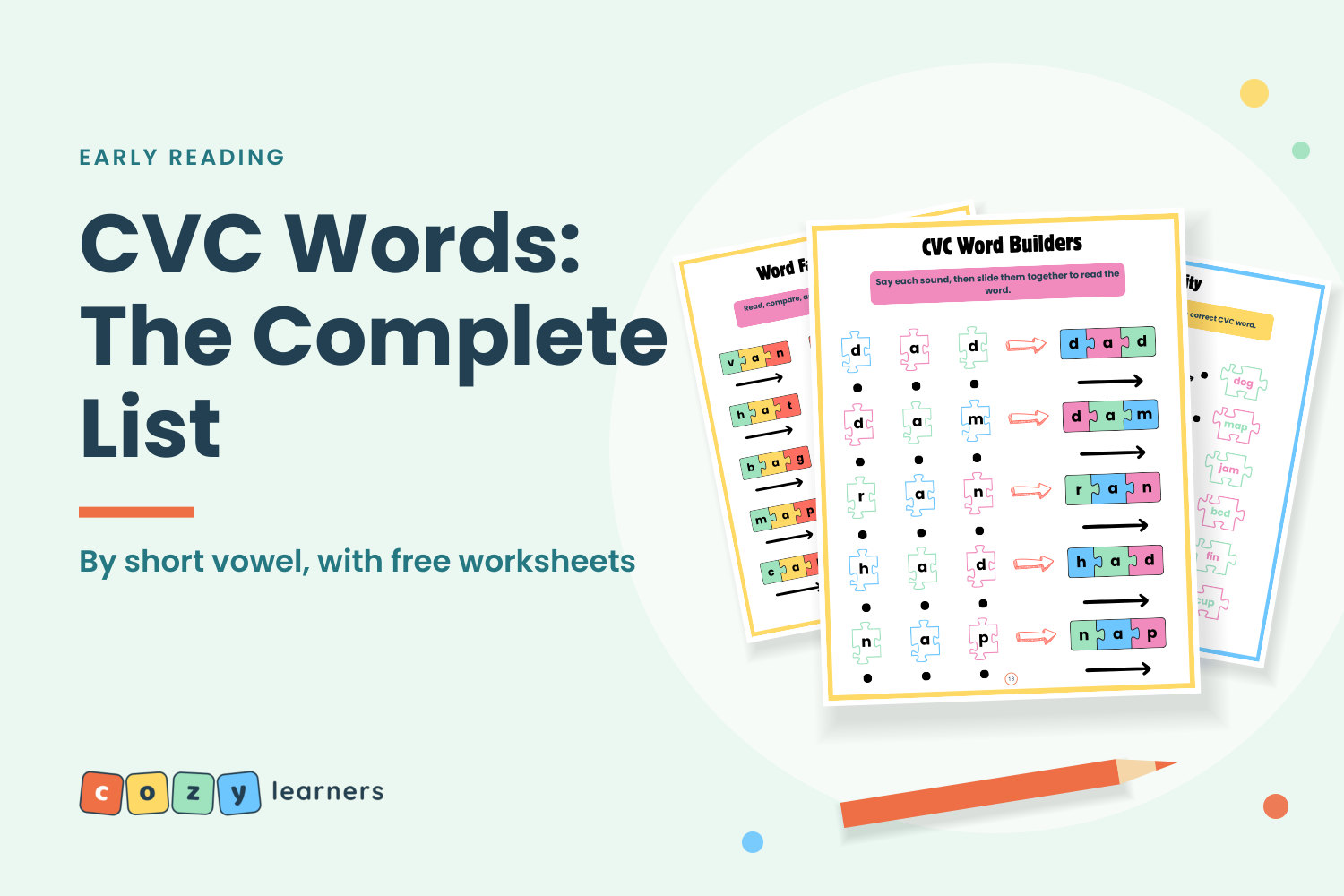
CVC words are the first words most children learn to read on their own: cat, sun, big, hop, red. Each one is three letters, and each letter makes its own sound, so a child who knows their letter sounds can work the word out — c-a-t, cat — without anyone telling them what it says.
This article explains what CVC words are, when your child is ready for them, gives you a list of more than 150 sorted by vowel, and shares simple ways to practice that take five minutes.
What are CVC words?
CVC stands for consonant – vowel – consonant. The word starts with a consonant, has a short vowel in the middle, and ends with a consonant:
- c-a-t — cat
- p-i-g — pig
- s-u-n — sun
The vowel in the middle always makes its short sound: the a in apple, the e in egg, the i in itch, the o in octopus, the u in up. There are no silent letters and no letter teams, which is why these are the words to start with.
When is a child ready for CVC words?
A good sign is that your child knows the sounds of most letters — not just their names. If you hold up m and they say /m/, and they can hear that sun starts with /s/, they are ready.
Most children get there somewhere between the ages of 4 and 6, often during kindergarten. If your child is still learning letter sounds, spend a few more weeks there first; CVC words will come much more easily.
The CVC word list, by short vowel
Teach one vowel at a time. Most programs start with short a, because it is easy to hear, then move through i, o, u and e — or in alphabetical order, which works just as well. Within each vowel, the words are grouped into word families: words that share their last two letters, like cat, hat, mat.
Short a CVC words
-at: bat · cat · hat · mat · pat · rat · sat · vat
-an: can · fan · man · pan · ran · tan · van
-ap: cap · gap · lap · map · nap · tap · yap
-ad: bad · dad · had · mad · pad · sad
-ag: bag · rag · tag · wag
-am: ham · jam · ram · yam
more: cab · lab · wax · zap
Short e CVC words
-et: bet · get · jet · let · met · net · pet · set · vet · wet · yet
-en: den · hen · men · pen · ten
-ed: bed · fed · led · red · wed
-eg: beg · leg · peg
more: gem · web · yes
Short i CVC words
-it: bit · fit · hit · kit · lit · pit · sit
-in: bin · fin · pin · tin · win
-ip: dip · hip · lip · rip · sip · tip · zip
-ig: big · dig · fig · jig · pig · wig
-id: did · hid · kid · lid
more: fix · him · mix · six
Short o CVC words
-ot: cot · dot · got · hot · lot · not · pot
-op: hop · mop · pop · top
-og: dog · fog · hog · jog · log
-ob: cob · job · sob
more: box · fox · mom · nod · pod · rod
Short u CVC words
-ut: but · cut · hut · nut
-un: bun · fun · run · sun
-ug: bug · dug · hug · jug · mug · rug · tug
-ub: cub · rub · sub · tub
-um: gum · hum · yum
more: bud · bus · cup · mud · pup
How to teach CVC words in five steps
1. Start with two sounds
Before three-letter words, blend two: a-t, at; i-n, in; u-p, up. Say the sounds slowly, then faster, until they run together. This is the whole trick of reading, in miniature.
2. Add the first sound
Now put a sound in front: m — at, mat. Many children find this easier than blending three separate sounds, because the end of the word is already familiar.
3. Tap and blend
Touch one finger for each sound — /c/ /a/ /t/ — then sweep your hand under the word and say it smoothly: cat. The tapping keeps the sounds in order; the sweep turns them into a word.
4. Change one letter
Make cat, then change one letter to make hat, then hot, then hop. These word chains teach your child to look at every letter, not just the first one.
5. Read them in sentences
As soon as your child can read a handful of CVC words, put them in short sentences with a few sight words: The cat sat on a mat. Reading a whole sentence on their own is a huge moment — and the best motivation there is.
Six no-prep CVC activities
- Word building: write letters on sticky notes and build words together. Swap the first letter to make a new word.
- CVC hunt: pick a picture book and hunt for three-letter words you can sound out.
- I spy: "I spy something that sounds like p-i-g." Your child blends the sounds and finds it.
- Robot talk: say a word in robot sounds — /d/ /o/ /g/ — and let your child say the real word.
- Picture match: draw a quick cat, sun and bed, write the words on cards, and match them.
- Write it: say a CVC word and let your child write one letter for each sound they hear.
Common mistakes
- Adding "uh" to sounds. Say /m/, not "muh"; /t/, not "tuh". Extra sounds make blending much harder: cuh-a-tuh does not sound like cat.
- Guessing from the first letter. If your child reads cat as car, point to each letter and tap it out again.
- Mixing vowels too soon. Stay with one vowel until those words are easy, then mix two, then all five.
- Long sessions. Five or ten minutes a day works far better than half an hour once a week.
Free CVC words worksheets
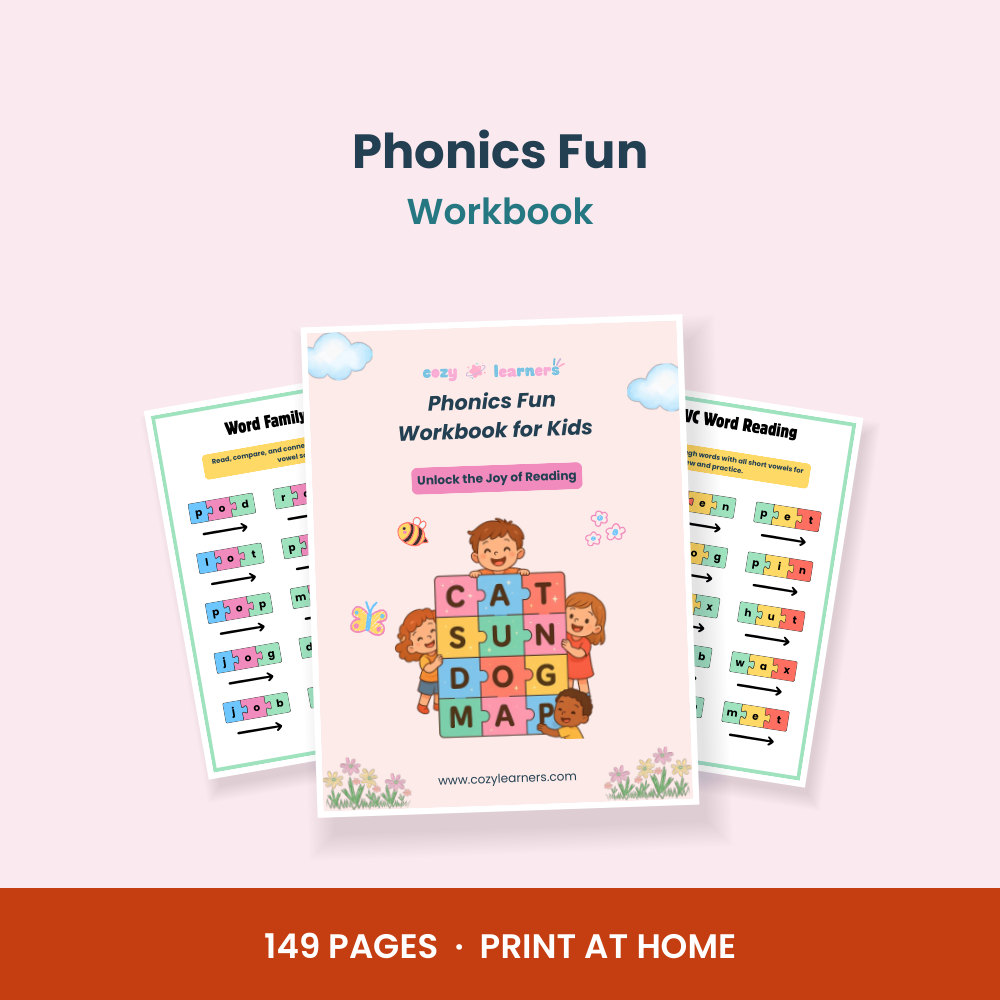
Our free CVC Words Worksheets are 12 pages from our phonics workbook, covering all five short vowels: word builders, word families, a word hunt, mixed reading, picture matching and a missing-letter page. They print on US Letter or A4.
After CVC words come blends (frog, stop), digraphs (ship, chin) and the magic e (cake, bike). Our Phonics Fun Workbook takes your child through every step, from letter sounds to a first story they can read alone. For the words that cannot be sounded out yet, like the and said, see our sight words list.
Free printable
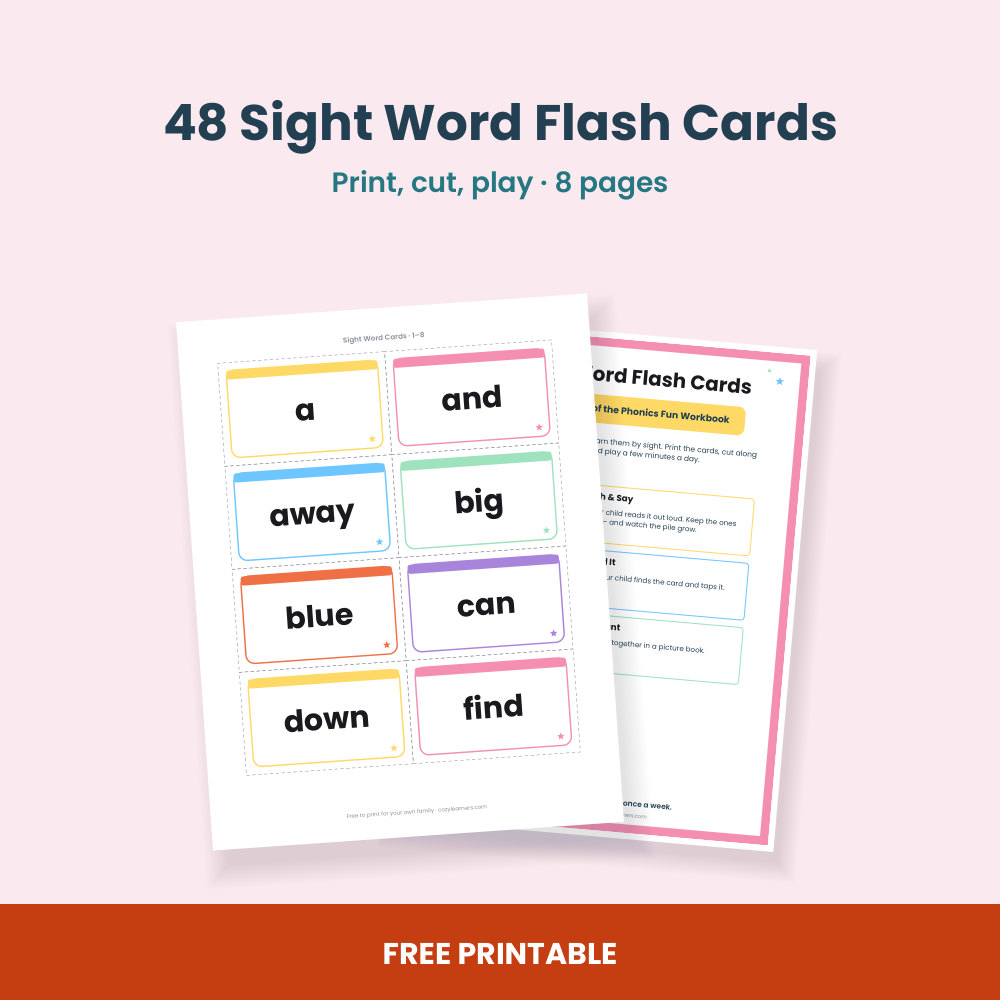
48 Sight Word Flash Cards
The 48 sight words of the Phonics Fun Workbook, as cards to print and cut — with three quick games to play with them.