"Kindergarten Science at Home: What to Teach and a Simple Plan"
What kindergarten science covers, a simple 20-minute routine for home, six easy experiments with things you already have, and free printable science worksheets for ages 4 to 6.
By Cozy Learners · · 4 min read
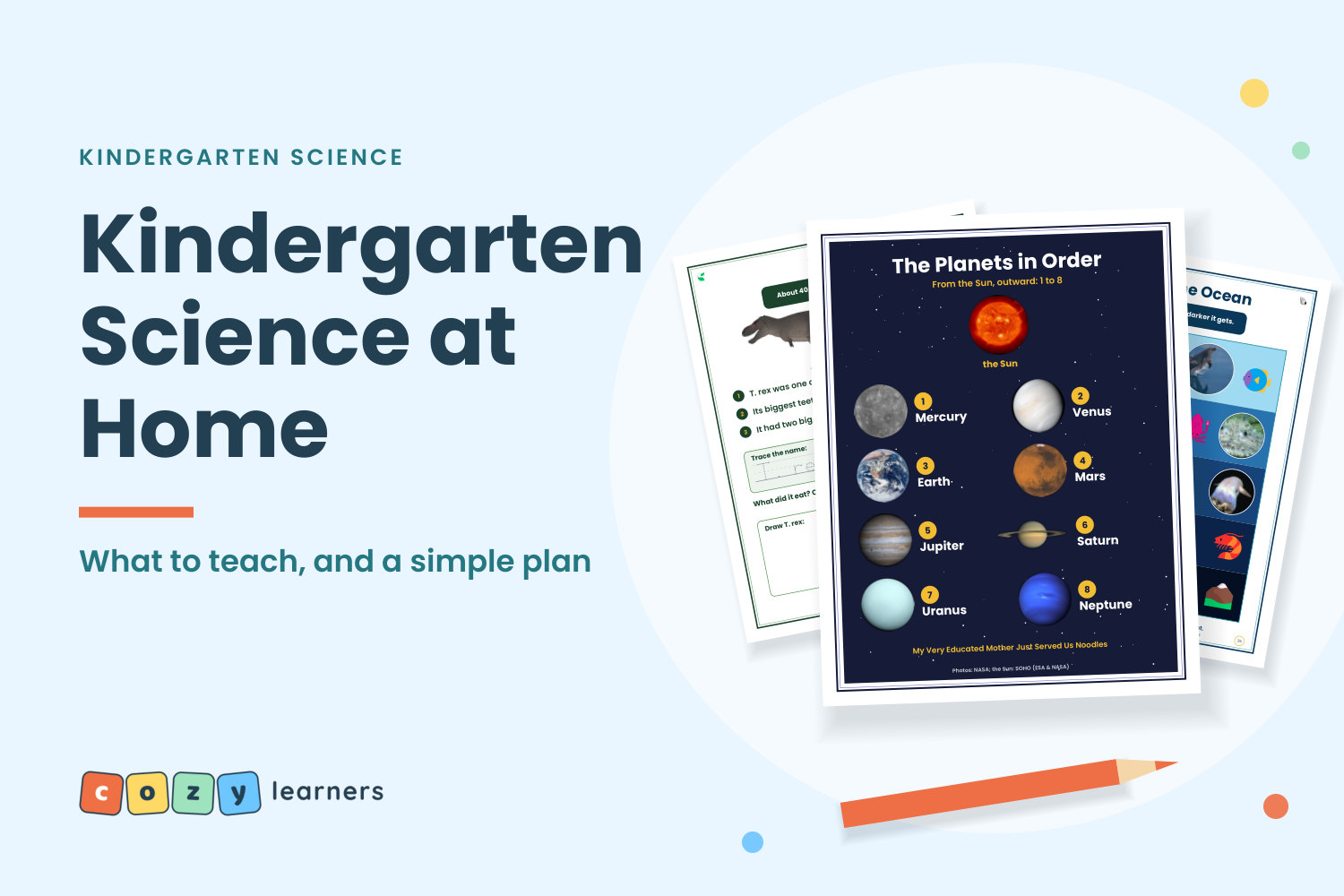
Kindergarten science is not about memorizing words. At 5, science is looking closely, asking "why?", trying something and seeing what happens. You don't need a lab or a science degree to teach it at home — a kitchen table, a few minutes a day and a topic your child already loves are enough.
What kindergarten science covers
Most US kindergarten standards (the Next Generation Science Standards that many states follow) ask five-year-olds to explore a few big ideas:
- Living things and what they need. Plants need water and light; animals need food, water and a place to live.
- Weather and the sky. Sunny, rainy, windy, cold — and how the Sun warms the ground.
- Pushes and pulls. What happens when you push a ball harder, or roll it into something.
- How living things change their surroundings — a squirrel burying nuts, roots cracking a sidewalk.
- Taking care of the Earth. Using less, throwing away less, keeping water clean.
Children this age learn these ideas best through topics they care about. Space, dinosaurs, the ocean, bugs, animals and plants are all ways in: a child who loves sharks will happily learn what an animal needs to live, as long as the animal is a shark.
A simple routine: 20 minutes a day
A short routine you can keep beats a big lesson you skip. One that works well at home:
- Read three facts aloud about the day's subject — one planet, one dinosaur, one sea animal. Three is enough to remember.
- Look at a real photo together. Real pictures of the Moon, a fossil or an octopus spark more questions than drawings.
- Do one small activity: sort, color, cut and paste, count, or a quick experiment.
- Draw it in a journal. One drawing a day of what they learned. Your child tells you what to write under it.
Ten minutes is fine on busy days. Three weeks on one topic, then move to the next, keeps interest high without rushing.
Six easy experiments with things you already have
- Sink or float. Fill a bowl with water and gather small objects: a spoon, a cork, a coin, a leaf, a toy. Guess first, then test. Sort them into two piles.
- The floating egg. Put an egg in a glass of tap water — it sinks. Stir in salt, spoon by spoon, until it floats. That's why it's easier to float in the sea.
- Moon craters. Fill a baking pan with flour, dust a little cocoa on top, and drop pebbles from different heights. Look at the craters and the "splash" around them.
- Balloon rocket. Thread a string through a straw, tie the string across a room, tape a blown-up balloon to the straw and let it go.
- Salt dough fossils. Mix flour, salt and water into a dough, press a toy dinosaur's feet or a shell into it, and let it dry.
- Day and night with a flashlight. In a dark room, shine a flashlight on a ball or a globe and turn it slowly. One side has day, the other has night.
Always do experiments together, and keep small objects away from children who still put things in their mouth.
Free kindergarten science worksheets
Start with one of our free printables:
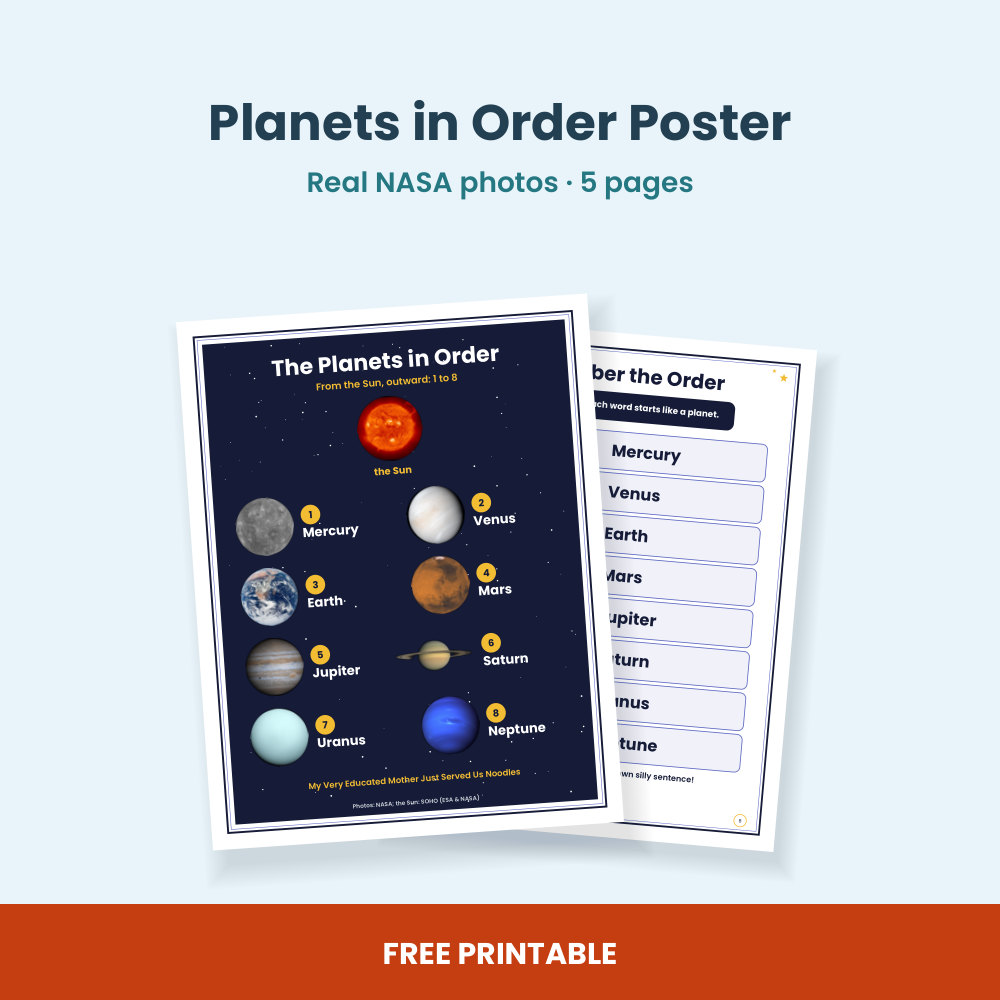
- Planets in order — a poster with real NASA photos and a cut-and-glue page.
- Parts of a plant — a plant, a flower and a tree, labeled on real photos.
- Butterfly life cycle — the butterfly and ladybug life cycles in real photos.
- Sea animals — twelve sea animals and their names in real photos.
Our science units for ages 4 to 6
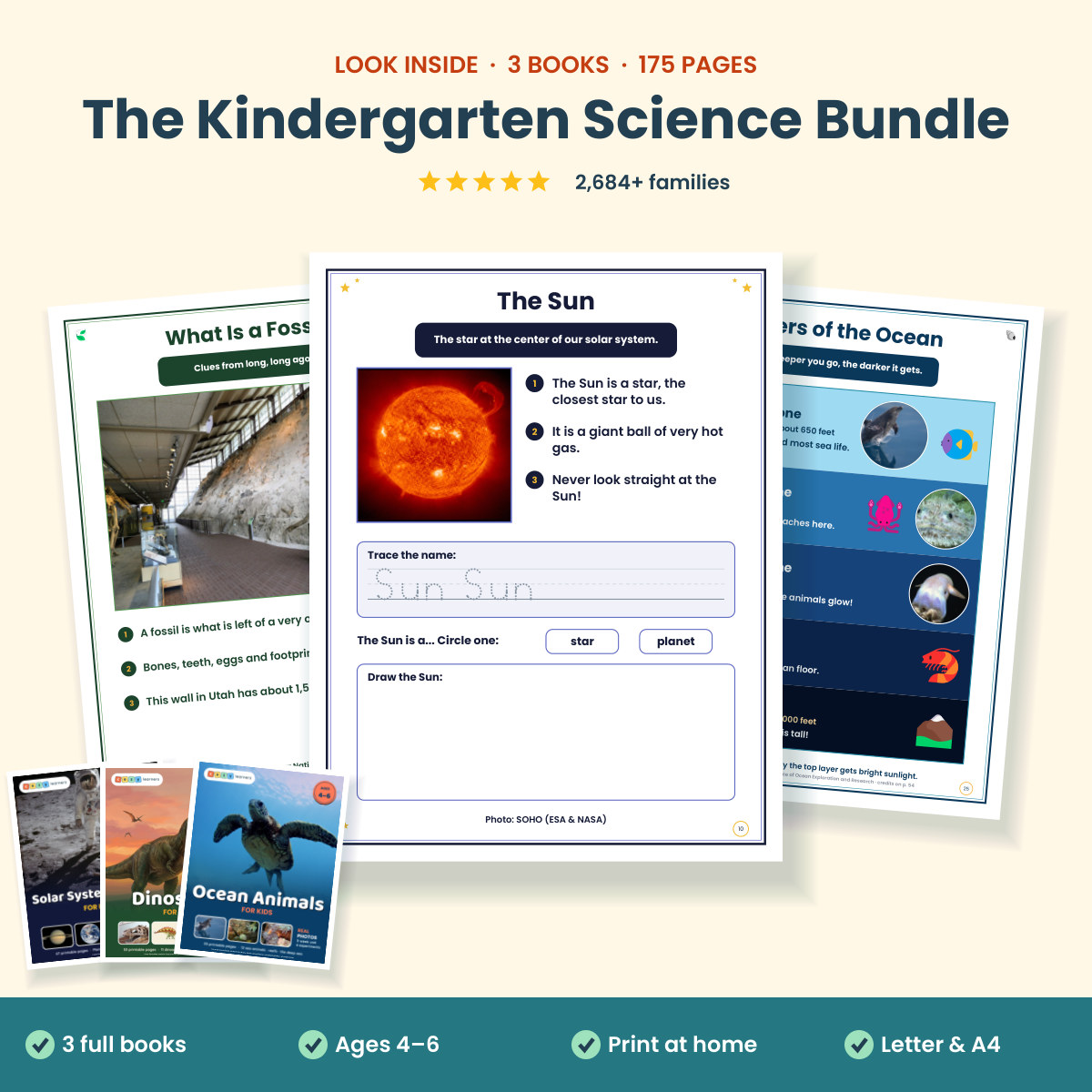
Each of our science books is a complete 3-week unit with real photos: 15 short lessons with three facts read aloud, one activity a day, hands-on experiments, a journal and a quiz.
- Solar System & Space for Kids — real NASA photos, a solar system model to hang, the Moon and its phases.
- Dinosaurs for Kids — 11 dinosaurs, real fossils, salt dough fossils and a frozen dino dig.
- Ocean Animals for Kids — 12 sea animals, the layers of the ocean, the floating egg and the blubber glove.
- Plants for Kids, Animals for Kids and Insects for Kids — with life cycles, stage by stage.
The Kindergarten Science Bundle puts space, dinosaurs and the ocean together: three units, 175 pages, 45 lessons and 18 experiments — nine weeks of science.
Free printable
Free Planets in Order Poster
A free printable poster of the planets in order with real NASA photos, a silly sentence to remember them, and a cut-and-glue page — from our Solar System & Space unit, for ages 4 to 6.