Kindergarten Math at Home: What to Teach and 10 Counting Activities
What kindergarten math covers, in plain words — counting to 100, numbers to 20, adding and taking away within 10, shapes — and ten hands-on activities to practice it at home.
By Cozy Learners · · 5 min read
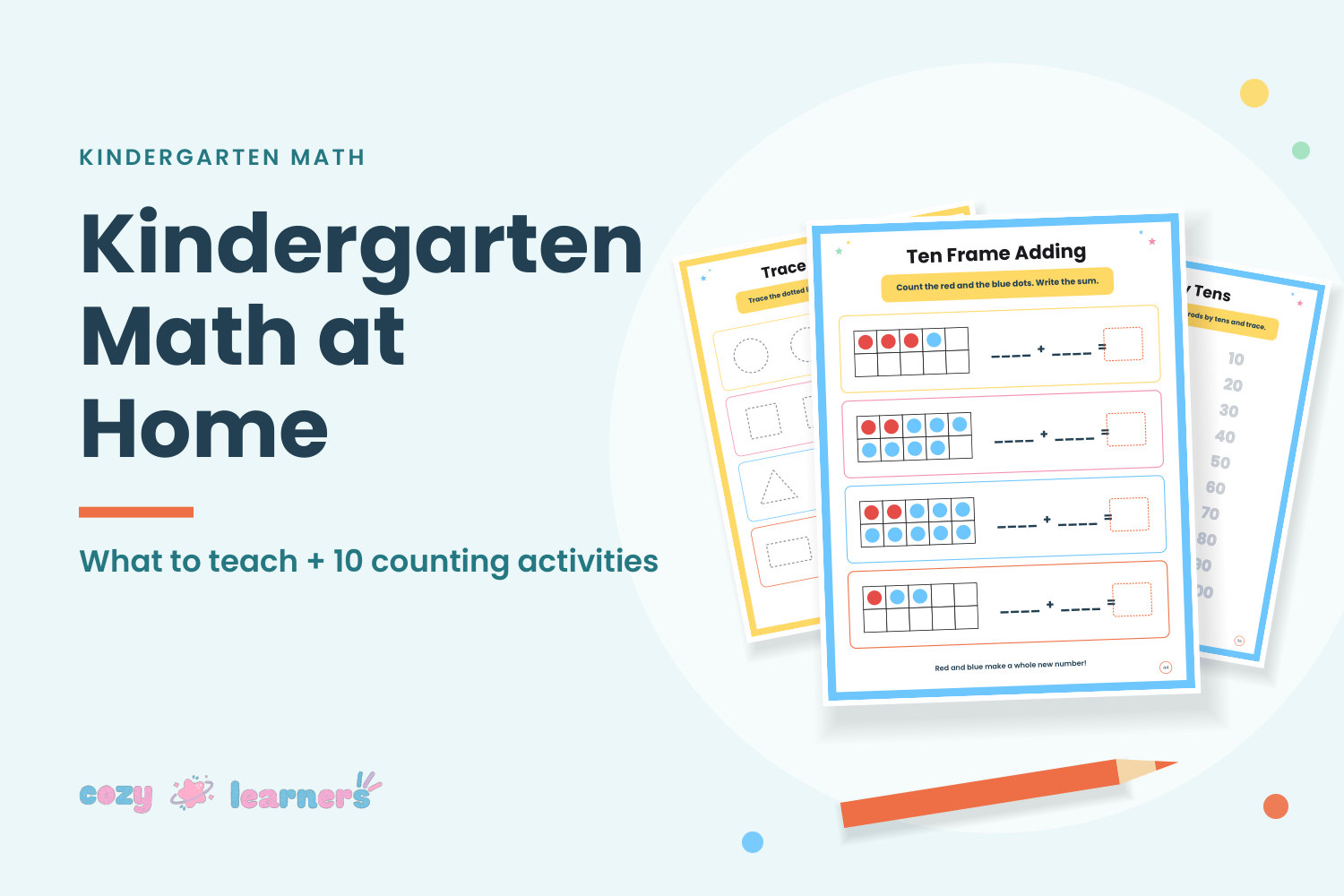
Kindergarten math is less about worksheets and more about understanding what numbers mean. A child who can count to 100 but can't tell you which pile has more crackers hasn't quite got it yet. A child who counts the crackers, sees that one pile has three more, and eats them to make it fair — that child is doing real math.
This guide explains what kindergarten math covers, then gives you ten activities to practice it with things you already have.
What kindergarten math covers
Most US kindergartens follow a similar set of goals. By the end of the year, children typically work on:
Counting and numbers
- Counting to 100 by ones and by tens
- Counting forward from any number ("start at 7 and keep going")
- Reading and writing numbers 0 to 20
- Counting up to 20 objects, and knowing the last number said is how many there are
- Comparing groups: more, fewer, the same
Adding and taking away
- Solving simple adding and taking-away problems within 10, using fingers, objects, drawings or a number line
- Breaking a number into parts: 5 is 4 and 1, or 3 and 2
- Finding the number that makes 10 with any number from 1 to 9
- Adding and subtracting within 5 quickly, from memory
Teen numbers
- Seeing numbers 11 to 19 as ten and some more: 14 is ten and four
That last idea is small but powerful. It is the first step toward place value, and it makes all later math easier.
Shapes and measuring
- Naming flat shapes (circle, square, triangle, rectangle, hexagon) and solid ones (cube, cone, cylinder, sphere)
- Position words: above, below, beside, in front of, behind
- Comparing longer and shorter, heavier and lighter
- Sorting objects into groups and counting each group
Many programs also add simple patterns and telling time to the hour.
How long should math take each day?
Ten to fifteen minutes of focused math is plenty for most five-year-olds, and two short sessions are often better than one long one. Most of the learning happens in everyday life: setting the table, sharing snacks, counting steps.
10 counting and math activities
1. Count and touch
Line up 10 small objects. Your child touches each one as they count. The touch matters: it builds one-to-one correspondence, the idea that each object gets exactly one number.
2. How many now?
Count a group of five buttons. Then hide one under your hand. "How many now?" Then add two. "How many now?" This is adding and taking away before any symbols appear.
3. Snack math
At snack time, give your child seven crackers and ask them to split them between two plates. How many ways can they do it? 4 and 3, 5 and 2, 6 and 1, 7 and 0. This is exactly the "break a number into parts" skill.
4. Egg carton ten frame
Cut an egg carton down to 10 cups (two rows of five). Fill it with pom-poms or beans. Seeing 7 as "a full row of five and two more" helps children recognize quantities without counting one by one.
5. Count by tens with straws
Bundle straws or craft sticks into groups of ten with a rubber band. Count the bundles: 10, 20, 30… Then build teen numbers: one bundle and four loose straws makes 14.
6. Number hunt
Look for numbers on house doors, license plates, clocks and price tags. Read them together. Which is bigger?
7. Stair counting
Count stairs going up, then count backward coming down. Start counting from a number other than 1: "We're on step 4. Let's keep counting."
8. Shape hunt
Go around the house looking for shapes: a circle clock, a rectangle door, a cylinder can, a sphere ball. Count how many of each you find.
9. Which is longer?
Pick two objects — a spoon and a pencil — and ask which is longer. Line them up at one end to check. Then use paper clips to measure each one: "The spoon is 6 paper clips long."
10. Dice games
Roll one die and move a toy that many spaces on a homemade track. Later, roll two dice and add. Board games like Chutes and Ladders are wonderful counting practice.
Where worksheets fit
Hands-on activities build understanding; a worksheet gives practice and shows you what has stuck. A good kindergarten math page uses pictures, ten frames and number lines rather than columns of bare numbers, and asks a child to do one thing clearly.
A balanced week might be three or four short worksheet pages, plus everyday activities like the ones above.
Signs your child is ready for more
- They count objects correctly without skipping or double-counting.
- They can tell which of two numbers up to 10 is bigger, without counting.
- They solve "I had 3, I got 2 more" problems with fingers or objects.
- They are curious about bigger numbers.
If those feel solid, move on to adding and taking away within 10, then teen numbers.
A workbook built around this
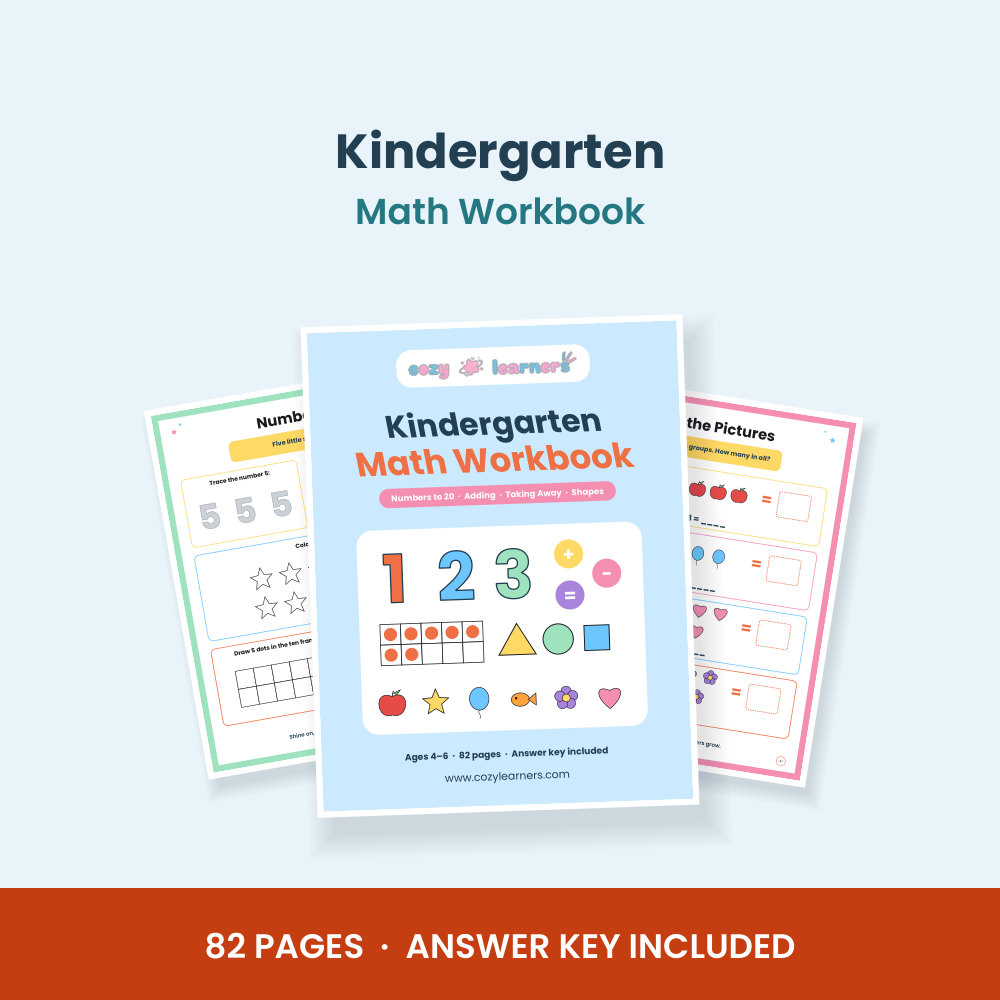
Our Kindergarten Math Workbook follows these goals step by step: a page for every number from 0 to 20, counting to 100 by ones and tens, adding and taking away within 10 four different ways, flat and solid shapes, position words, measuring, sorting, patterns and telling the hour. Teen numbers are shown as ten and some more, and there is an answer key for grown-ups at the back.
It is 82 pages, Letter size, ready to print. For the rest of the kindergarten year — reading, letters, fine motor and more — see how kindergarten at home can fit together in one simple plan.