How to Homeschool Kindergarten: A Simple Plan for the Whole Year
What kindergarten at home really takes — how many hours a day, what to teach, how to plan 36 weeks, and the few things you can skip.
By Cozy Learners · · 7 min read
Homeschooling kindergarten sounds like a big decision, and in a way it is. But the day-to-day work is smaller than most parents expect. A five-year-old does not need six hours of school. They need a short, steady routine, a grown-up who reads with them, and a plan that keeps the year moving forward.
This guide walks through what that looks like: how long a school day lasts, what a kindergartener learns, how to plan the year, and what you can safely leave out.
First, check your state's rules
Homeschool law is set state by state, and the rules for kindergarten vary. In many states, kindergarten is not compulsory at all, because the compulsory school age starts at six or later. In others, you may need to file a notice of intent or keep simple records.
Before you buy anything, look up your own state. The Home School Legal Defense Association keeps a plain-language summary for every state at hslda.org. It takes ten minutes and saves a lot of worry.
How many hours a day?
Far fewer than a school day. A classroom spends much of its time on things a family does not need: lining up, waiting for turns, moving thirty children from one activity to the next. At home, the teaching part of kindergarten often takes 45 minutes to an hour and a half, split into short pieces.
A rhythm that works for many families:
- 15 to 20 minutes of reading and letters — a phonics page, a few sight words, a picture book read aloud.
- 10 to 15 minutes of math — counting real things, a worksheet, a game.
- 10 to 20 minutes of something with hands — cutting, tracing, coloring, a puzzle.
- The rest of the day is play, outside time, chores, and books. That is learning too, and at this age it counts for a lot.
If your child is done and happy after 40 minutes, that was a good day. If they melt down at minute ten, stop and try again after a snack. Short and consistent beats long and heroic.
What does a kindergartener learn?
You do not need a school's scope and sequence to know what matters. Most kindergarten programs in the US cover roughly the same ground:
| Area | By the end of the year, most children… |
|---|---|
| Letters and sounds | know the letters, upper and lower case, and the main sound each one makes |
| Early reading | blend sounds into short words like cat, sun, hop, and read a handful of sight words |
| Writing | write their name and most letters, and copy a short word |
| Numbers | count to 100 by ones and tens, write numbers to 20, compare small groups |
| Adding and taking away | solve simple problems within 10, with fingers, objects or pictures |
| Shapes and measuring | name flat and solid shapes, compare longer, shorter, heavier, lighter |
| Fine motor | hold a pencil well, cut along a line, trace and color with control |
| Living together | take turns, name feelings, follow two-step directions |
Children reach these at different times. A child who is reading by October and a child who is still learning letter sounds in March are both normal kindergarteners. Your job is the next step, not the finish line.
Plan the year in weeks, not in topics
The most common reason a homeschool kindergarten stalls is not the child. It is the plan. A pile of workbooks and a Pinterest board give you plenty of material and no answer to the question every morning asks: what do we do today?
A school year has about 36 weeks. If you decide in advance that you will teach four days a week, you get 144 school days, which leaves Fridays free for library trips, field trips, or catching up. That is the whole framework.
From there:
- Pick one spine for each subject. One reading program, one math book. Switching programs every month is how gaps appear.
- Divide each one across the weeks. A 150-page phonics workbook is about four pages a week. Write it down once and you never have to think about it again.
- Leave slack. Plan 32 weeks of content for a 36-week year. Someone will get sick, and grandparents will visit.
- Tick things off. A simple chart on the fridge does more for a five-year-old's motivation than any reward app.
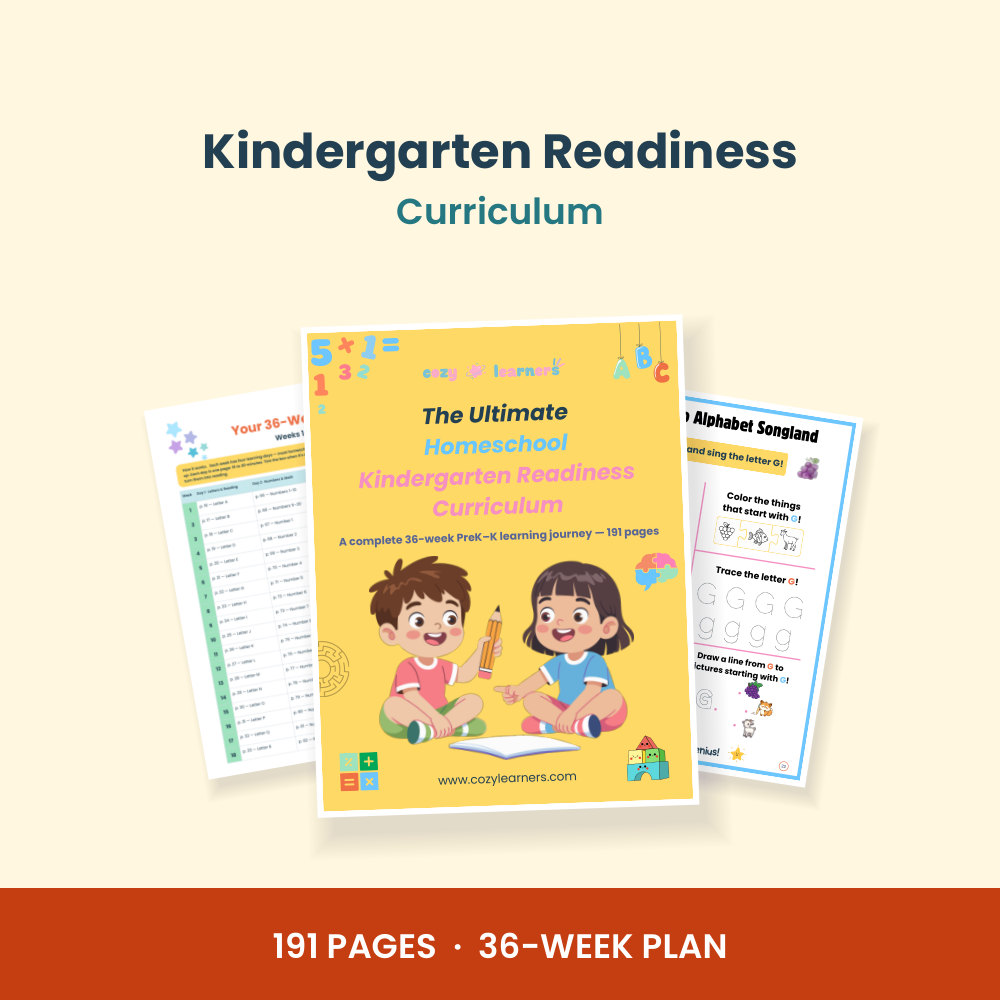
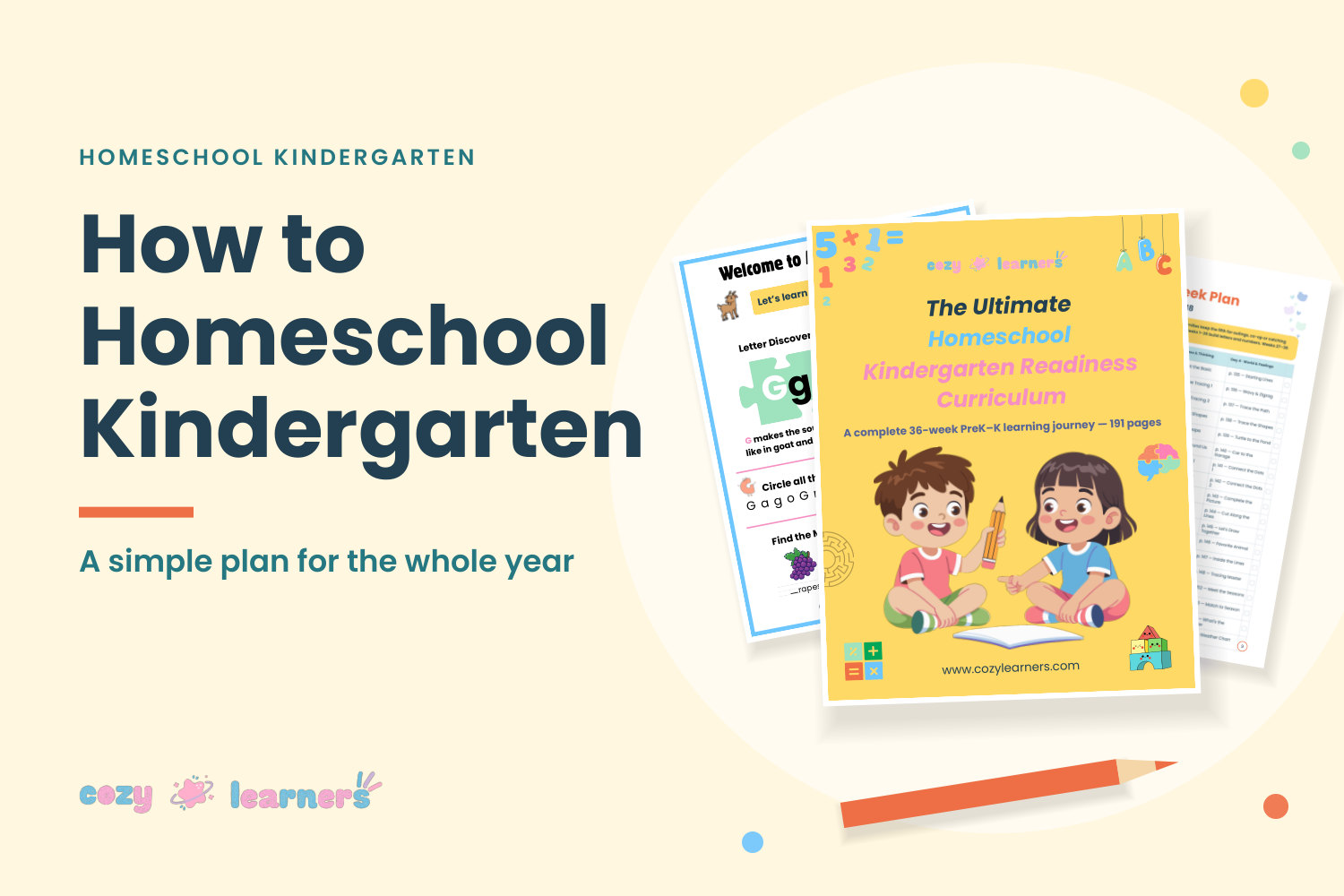
This is exactly the problem our Kindergarten Readiness Curriculum was built around: its 36-week plan gives every school day a real page number, so the planning is already done.
What you need (and what you can skip)
You need less than the catalogs suggest.
Worth having:
- A printer and a ream of paper. Printable workbooks pay for themselves the second time you print a page.
- Thick crayons, pencils, child-safe scissors and a glue stick.
- A library card. Picture books are your biggest and cheapest curriculum.
- Something to count with: buttons, dried beans, small blocks.
- A folder or binder for finished pages, so your child can see how far they have come.
Safe to skip at this age:
- Expensive boxed curricula with a teacher's manual for every subject.
- Laminators, pocket charts and classroom decor.
- Screens as the main teacher. A good app can help with practice, but a five-year-old learns to read best with a person next to them.
- Grades. A kindergartener needs to know they did well, not that they got a B.
A sample week
Here is what one ordinary week can look like, four days on and one day off:
- Monday — Reading: the letter sound of the week, one page. Math: count objects to 10. Hands-on: trace and color.
- Tuesday — Reading: blend three short words. Math: a number page. Hands-on: cut along lines.
- Wednesday — Reading: two new sight words and a read-aloud. Math: a shape hunt around the house. Hands-on: a simple puzzle.
- Thursday — Reading: read the week's words again. Math: add with buttons. Hands-on: draw a picture and tell its story.
- Friday — library, park, baking, or a rest day.
Nothing on that list takes more than 20 minutes.
When it does not go to plan
Some days, your child will refuse. Some weeks, you will skip three days. This is normal, and it is the main advantage of teaching at home: you can slow down when they need it and move on when they are ready.
A few things help:
- Start at the same time each day, ideally right after breakfast, when everyone is fresh.
- Stop while it is still going well. Ending on a success makes the next day easier.
- Follow interest. If they want to count every stair in the house, that is today's math.
- Check progress every few weeks, not every day. Our free Kindergarten Readiness Checklist lists 30 skills in six areas — a quick way to see what is solid and what needs another month.
Where to start
If you are still deciding, try one week before you commit to a year. Our free Week 1 sample is the first week of the plan exactly as it appears in the book: four days, four pages, and the guide that explains the method. Print it, try it with your child, and see how it feels.
Kindergarten at home does not have to be complicated. One short routine, one plan, and a lot of books will take you a long way.