What Is Phonics? A Parent's Guide to Teaching It at Home
Phonics is how children learn that letters stand for sounds, and that sounds blend into words. What it is, why it works, and the order to teach it in at home.
By Cozy Learners · · 5 min read
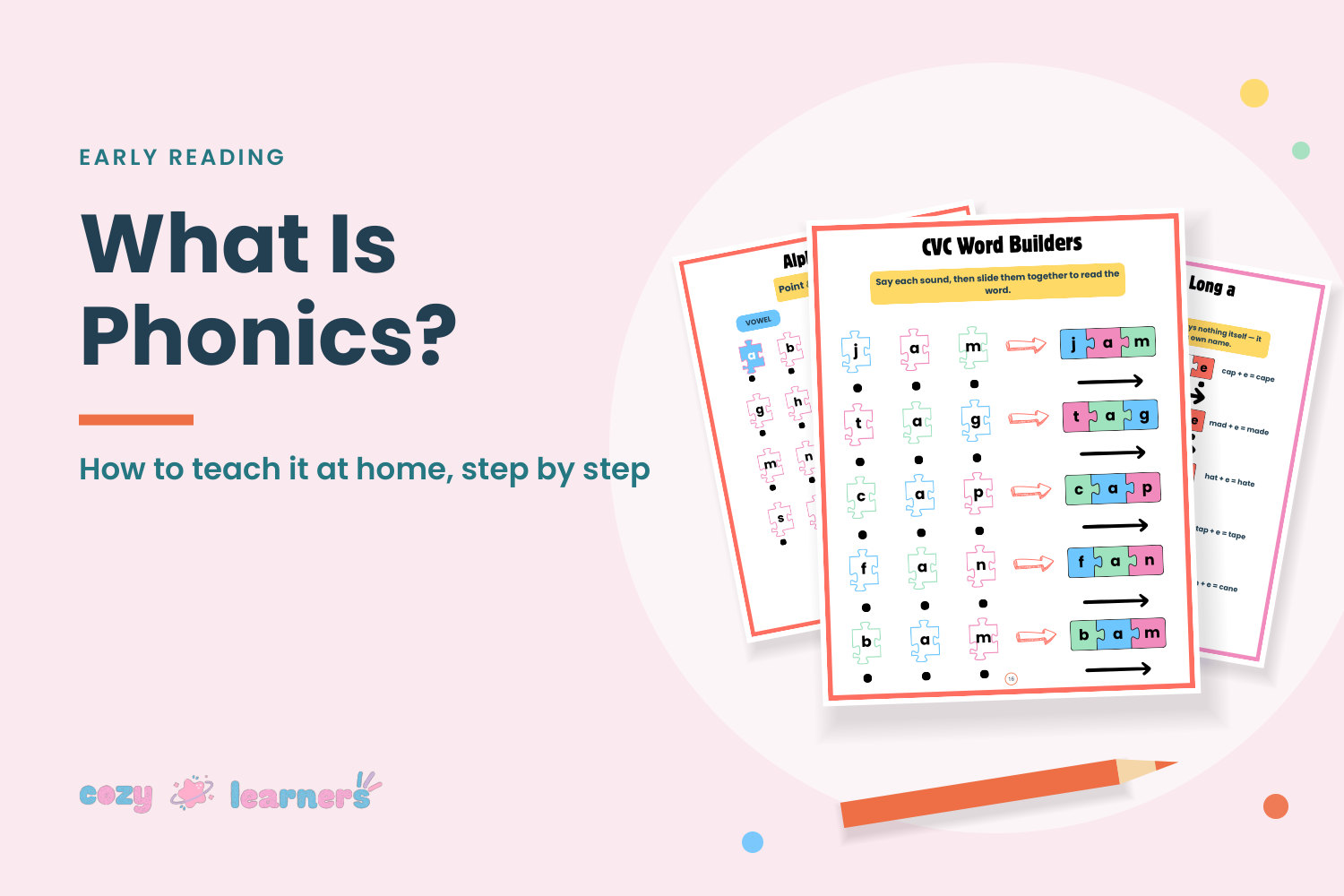
Phonics is the part of reading that connects letters to sounds. When a child learns that m says /m/, that a says /a/, and that /m/ + /a/ + /t/ blends into mat, they are learning phonics.
It sounds simple, and in a way it is. But it is also the most important thing a young reader learns, because it gives them a key to words they have never seen before.
Why phonics works
English is written with 26 letters, and those letters stand for about 44 sounds. Once a child knows the main sound for each letter and how to blend sounds together, they can sound out thousands of words without memorizing any of them.
The alternative — learning each word as a picture, or guessing from the first letter and the illustration — works for a while and then falls apart. A child can memorize a few hundred words by sight. They cannot memorize the tens of thousands they will meet by third grade.
This is not a matter of opinion. In 2000, the US National Reading Panel reviewed the research on teaching reading and found that systematic phonics instruction — teaching letter-sound relationships in a planned order — significantly improved children's reading, especially in kindergarten and first grade. Later research has kept confirming it.
Phonics vs. phonemic awareness
These two get confused often.
- Phonemic awareness is about hearing sounds in spoken words, with no letters at all. Can your child tell you that sun starts with /s/? That cat and hat rhyme? It is a listening skill.
- Phonics is connecting those sounds to letters on the page.
Phonemic awareness comes first and keeps growing alongside phonics. If your child struggles to blend written words, it is often worth stepping back to the listening games in our article on phonemic awareness activities.
The order to teach phonics in
A good phonics program builds one step on the last. Here is the usual sequence, and roughly where most children are at each point.
1. Letter sounds
Teach the most common sound for each letter. Say the sound short and clean: /m/, not "muh." Many programs start with letters that are easy to say and combine, like s, a, t, p, i, n, so children can build words within the first few weeks.
2. Blending
Blending is the moment reading clicks. Say the sounds slowly, then faster, until they run together: /s/… /a/… /t/… sat. Start with two-letter words (at, in, up), then move to three.
3. Short-vowel words (CVC)
Consonant-vowel-consonant words — cat, pig, sun, hop, bed — are the backbone of early reading. Work through one vowel at a time, then mix them.
4. Word families
Once a child can read cat, they can read hat, mat, sat, bat by changing one sound. Word families build speed and confidence.
5. Blends and digraphs
Blends are two consonants where you hear both sounds: st, bl, fr. Digraphs are two letters that make one new sound: sh, ch, th, wh, ng. These come after children are confident with short vowels.
6. Long vowels and other patterns
The "magic e" (or silent e) that turns cap into cape and kit into kite; then vowel teams and "bossy R" (car, her, bird). Many children meet these at the end of kindergarten or in first grade.
Alongside: a few sight words
Some very common words don't follow the rules a beginner knows yet — the, said, you, was. A small set of them, taught alongside phonics, lets children read real sentences early. Our sight words list has the 48 we use.
How to teach a phonics lesson at home
Keep it short and predictable. A 10- to 15-minute lesson can look like this:
- Review (2 minutes): flash through the sounds already learned.
- New sound (3 minutes): introduce one letter or pattern. Say it, trace it, find it in a few words.
- Blend (5 minutes): read a short list of words that use it. Point under each letter as your child says the sound, then sweep your finger to blend.
- Read (3 minutes): a phrase or sentence with those words.
- Stop while it is still going well.
A few habits that help:
- Don't guess from pictures. Cover the picture if your child looks at it instead of the word.
- Let them sound it out, even when it is slow. Jumping in with the answer teaches them to wait for you.
- Reread. Reading the same word list or sentence two or three days in a row builds fluency.
- Mix in writing. Spelling a word sound by sound is phonics backwards, and it reinforces both.
How long does it take?
It varies a lot. Many children work through letter sounds, blending and short-vowel words over the course of kindergarten, and move into blends, digraphs and long vowels in first grade. Some go faster. Some need more time on blending before it clicks.
What matters is steady progress in order. If a step feels shaky, stay there a little longer. Speed comes later.
A workbook that follows this order
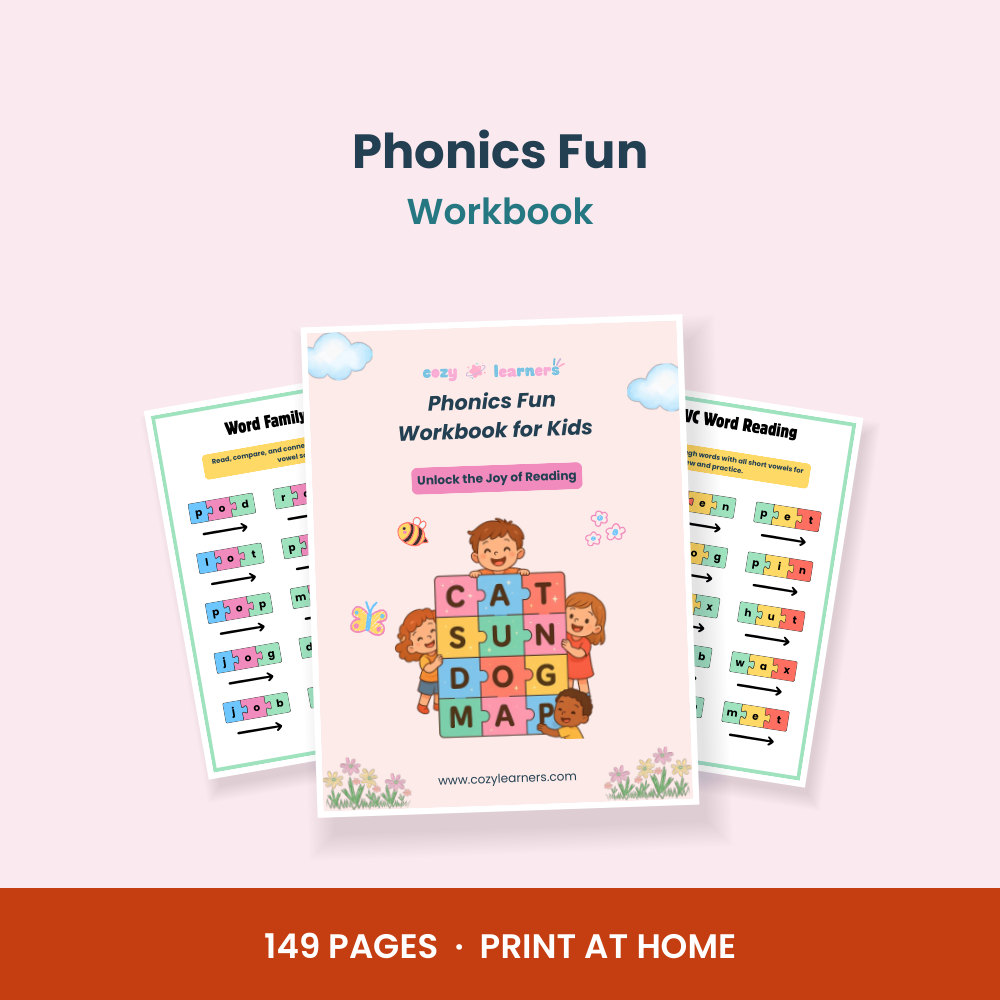
Our Phonics Fun Workbook is 149 pages built on this exact sequence: letter sounds, two-letter words and blending grids, CVC words with all five vowels, word families, then blends, digraphs, magic e, trigraphs and bossy R, with 48 sight words along the way. It ends with a first story your child can decode alone.
To get started today, print our free 48 Sight Word Flash Cards — the same words as the workbook, with three quick games to play.