Preschool Worksheets: What to Practice at 3, 4, and 5 (and How Much)
The six skills preschool worksheets should cover — tracing, cutting, shapes and colors, numbers, letters, and thinking skills — what each looks like at 3, 4, and 5, how many pages a day is enough, and free printables to start with.
By Cozy Learners · · 6 min read
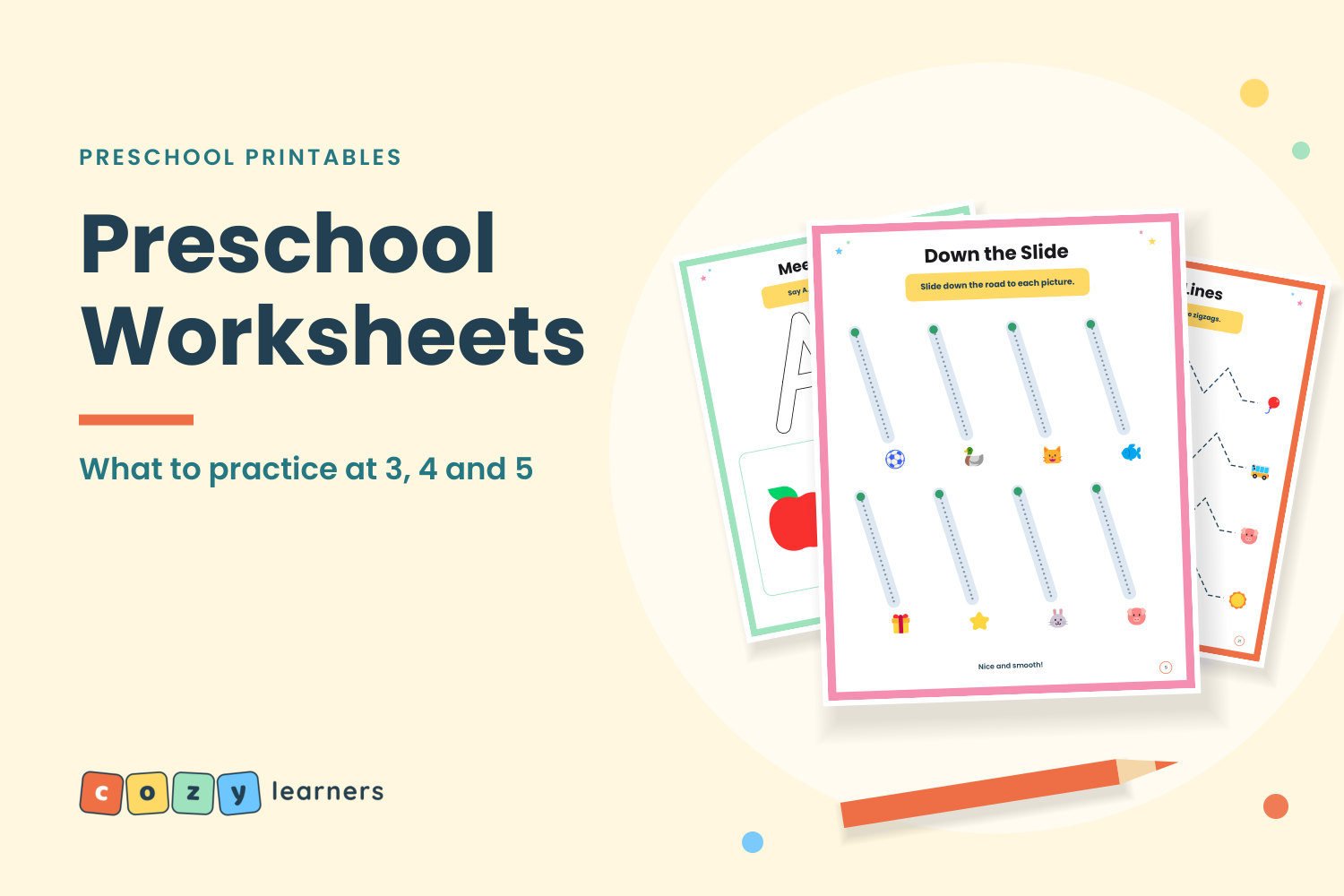
A good preschool worksheet is short, clear, and a little bit fun. It asks a three- or four-year-old to do one thing — follow a road with a crayon, cut along a line, find every letter A — and it ends before attention does.
This guide covers what preschool worksheets should practice, what that looks like at ages 3, 4, and 5, how many pages are enough, and how to make them work at home. There are free printable pages to start with at the end.
Are worksheets right for preschoolers?
In small doses, yes. Most of what a preschooler learns comes from play, books, and talking with you, and that should stay true. But a few minutes a day with a crayon and a page builds things play alone builds slowly: a steady pencil grip, scissor control, and the habit of sitting down to finish one small task.
The rule of thumb is simple: one or two pages, about ten minutes, and stop while it is still fun. A child who asks for "one more" tomorrow is learning more than a child who did five pages today and cried on the fifth.
The six skills preschool worksheets should cover
1. Tracing lines and paths
Before letters come lines. Tracing straight roads, slanted slides, waves, zigzags, loops, and spirals teaches the hand to start in one place and travel to another without lifting. These are the same strokes that make up every letter, which is why they come first.
- Age 3: wide roads, straight and gently curved, with a picture at the end to reach.
- Age 4: waves, zigzags, and circles; starting at a green dot and going the right way round.
- Age 5: loops and spirals, and the first letters traced on lines.
2. Cutting practice
Scissor work builds the hand strength that writing needs later. Start with short straight lines from the edge of the paper, then move to zigzags, waves, and steps, then shapes to cut out.
- Age 3: snipping strips of paper; short straight lines.
- Age 4: longer lines, slanted lines, gentle curves.
- Age 5: zigzags, corners, circles, and a spiral.
Use child-safe scissors, stay close, and print cutting pages on one side of the paper — card stock is easier for small hands if you have it.
3. Shapes and colors
Naming eight shapes (circle, square, triangle, rectangle, oval, diamond, star, heart) and eight colors gives a child the words to describe the world. The best pages mix three things: trace the shape, find it among others, and color it.
4. Numbers 1 to 10
At this age, a number is three things that belong together: the written numeral, the word, and a group of objects you can count. A good number page shows all three — trace the 3, count three apples, color three stars — so the child connects them instead of memorizing a shape.
5. Letters and their sounds
Preschool letter work is about recognizing letters and hearing their sounds, not writing perfect words. Pages that ask a child to find every A and a among other letters, dot the letter with a dot marker, or say which picture starts with /b/ build exactly the skills a kindergarten teacher hopes to see.
A letter a week is a comfortable pace: twenty-six weeks fits easily into a school year.
6. Thinking skills
Same and different, big and small, more and fewer, what comes next in a pattern, and simple mazes. These pages look like games, and they quietly build the attention and logic that math and reading rest on.
How many worksheets a day?
| Age | Pages a day | Minutes |
|---|---|---|
| 3 | 1 | 5–10 |
| 4 | 1–2 | 10 |
| 5 | 2 | 10–15 |
These are ceilings, not targets. Some days your child will want three pages; some days none. Both are fine.
Tips that make worksheets work
- Sit beside your child. Read the instruction aloud and point. At this age the worksheet is something you do together.
- Talk while you work. Name the colors, count out loud, say the letter's sound. What your child hears matters as much as what goes on the page.
- Use fat crayons and short pencils. They help small hands find a good grip without being told.
- Try dot markers. Bingo daubers turn letter and number pages into a game. No markers? Stickers or a crayon dot work too.
- Praise the trying, not the neatness. "You stayed on the road!" goes further than a correction. Wobbly lines are how steady lines begin.
- Print in the right size. US Letter in the United States and Canada, A4 almost everywhere else, so nothing is cut off.
When to put the worksheets away
If your child is tired, frustrated, or would rather build with blocks, let them. A worksheet that ends in tears teaches that worksheets end in tears. Play, read a book together, and try again tomorrow. For more on what a preschool day at home can look like, see Homeschool Preschool: What Your 3- or 4-Year-Old Really Needs.
Free preschool worksheets to start with
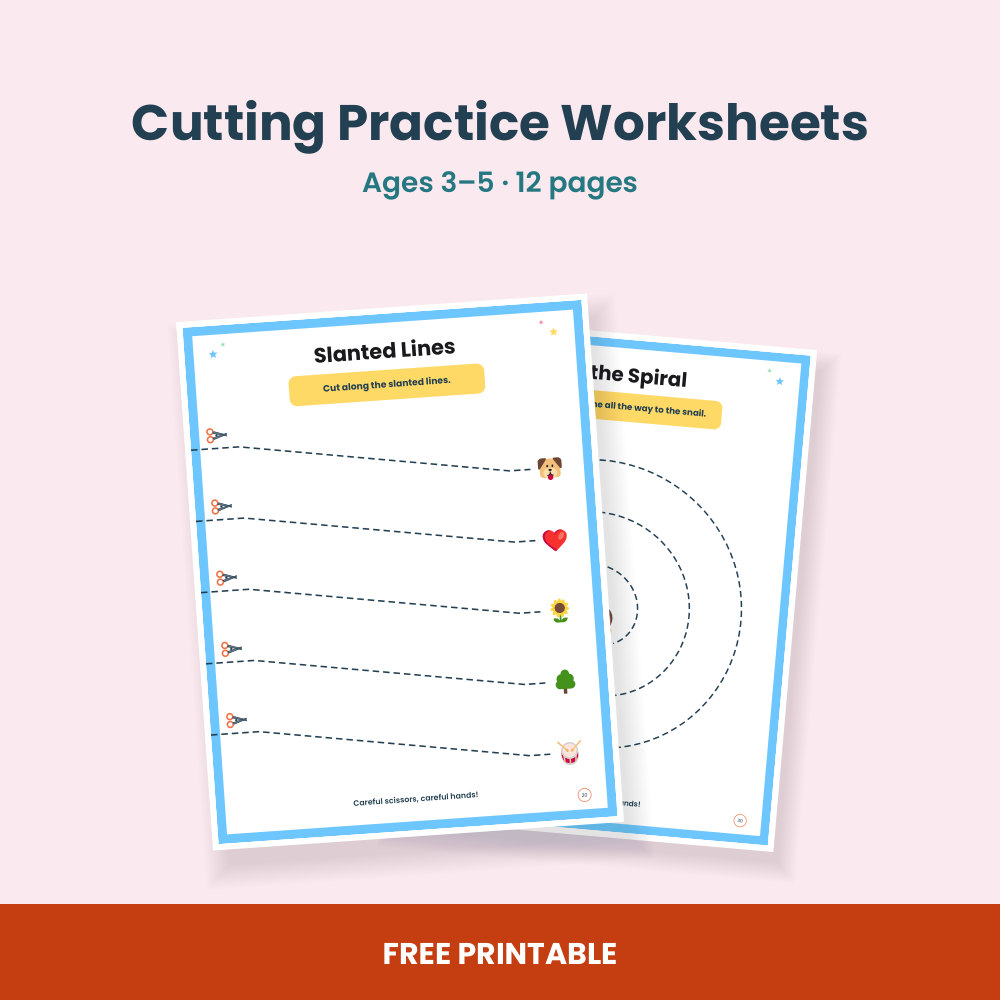
- Cutting Practice Worksheets — 10 pages from straight lines to a spiral, every line starting at the edge of the paper.
- Letter Tracing Worksheets — the letters A to E, capital and lowercase, for a child ready to trace letters.
Want a full year of preschool pages?
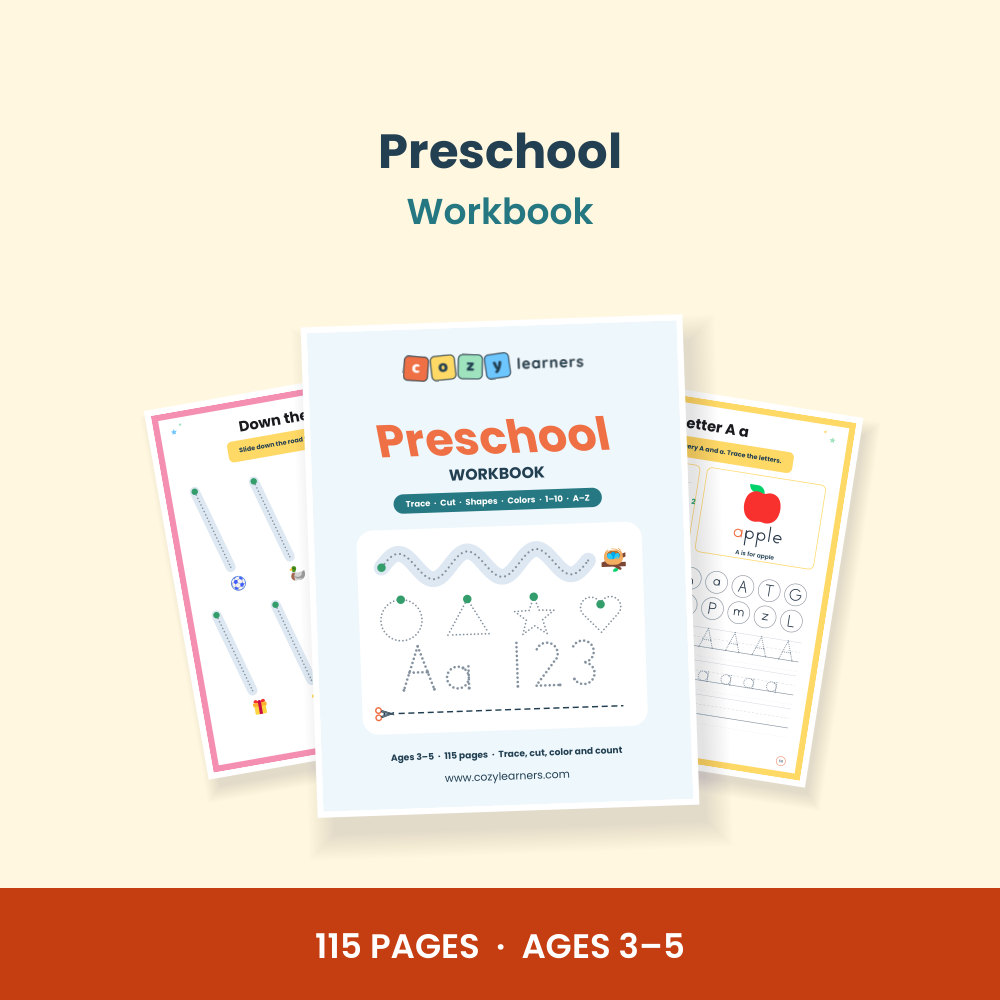
The Preschool Workbook gathers all six skills in 115 pages, in the order a preschooler grows: tracing paths, 13 cutting pages, shapes and colors, numbers 1 to 10, every letter from A to Z with beginning sounds, then patterns and eight mazes.
The Preschool Alphabet Workbook gives every letter four pages — color it, dot it, find it in a maze, and trace it — for a letter a week.
Together they are the Preschool Bundle, for less than the two books bought separately. Every page prints at home in US Letter and A4.
Free printable
Cutting Practice Worksheets
10 cutting practice worksheets from our Preschool Workbook, for ages 3 to 5: straight, slanted, zigzag, wavy, hill and step lines, circles to cut out, and a spiral.